

 English
 русский
 Español
 عربى


Jet torches answer one narrow question very well: how do you keep a hot, focused flame alive when the air around it is moving? The short answer is that you stop burning gas at atmospheric pressure. A jet torch forces pressurized fuel through a pinhole-sized nozzle, mixes it with air, and burns the mixture as a needle-shaped blue flame. A conventional flame lighter does none of that, which is why a light breeze bends its soft yellow flame and a stronger gust puts it out.
What follows is a working guide for buyers, product managers and sourcing teams: what a jet torch actually is, how it differs from an electronic windproof lighter, which fuel suits which climate, and which specifications are worth pinning down before a bulk order is placed.
What a Jet Torch Is and How It Produces a Blue Flame
A jet torch is a gas ignition tool that burns premixed, pressurized fuel through a narrow nozzle to produce a concentrated blue flame instead of a soft yellow one. The word "jet" describes the gas stream, not the body style, so a pocket torch, a pen torch and a gun-style igniter can all be jet torches.
Four parts do the work:
- Fuel reservoir. Refined butane, or a butane-propane blend, sits in a sealed tank at a few bar of pressure at room temperature. That internal pressure, not a pump, is what drives the gas out.
- Orifice and nozzle holder. An opening a fraction of a millimetre wide accelerates the gas and shapes it into a thin, fast stream.
- Air mixing chamber. The moving gas stream draws air in through side vents and mixes with it before the flame front. This is why the flame burns blue rather than yellow, and why it stays anchored in wind.
- Ignition system. A piezo crystal or an electronic arc discharges at the nozzle mouth. Because the gas is already travelling quickly, a jet torch needs a stronger and more repeatable spark than a soft-flame lighter.
Two design choices follow from this. Flame shape is set by the nozzle: a single orifice gives a needle flame for precision work, while a cluster of orifices or a slotted nozzle gives a wider fan flame for heating a larger area. Case material is the second choice, and it matters less than many buyers assume — the nozzle holder and the valve usually fail long before a steel shell does.
Blue flame versus yellow flame in practice
A blue jet flame delivers its heat into a small area at high temperature, while a yellow flame spreads lower heat over a wider area. That one difference explains most of the trade-offs in this article: faster lighting, shorter burn time per fill, and a greater need for care around nearby surfaces.
Jet Torch vs. Windproof Lighter vs. Standard Lighter
The three tools separate mainly on flame temperature, wind tolerance, fuel consumption and refill behaviour, not on price. The table below is written for specification work rather than marketing copy.
| Attribute | Jet torch (blue flame) | Electronic windproof lighter | Standard flame lighter |
|---|---|---|---|
| Flame shape | Needle or fan, sharply defined | Short, upright, partly shielded | Soft, teardrop-shaped |
| Core flame temperature | Roughly 1,200-1,300 degrees Celsius | Roughly 1,000-1,100 degrees Celsius | Roughly 800-1,000 degrees Celsius |
| Wind tolerance | Holds in strong steady wind; sensitive to sharp crosswind gusts | Good in moderate wind, less stable in gusts | Fails in light to moderate wind |
| Fuel | Refined butane, sometimes butane-propane blends | Refined butane | Refined butane |
| Continuous burn per fill | Shortest of the three at full output | Longer than a jet torch | Longest at low output |
| Typical use | Heating metal or glass, cigars, outdoor ignition, craft work | Cigarettes, candles, kindling in breezy conditions | Cigarettes and candles indoors |
| Main risk | Overheating nearby surfaces; flare after overfilling | Trigger pressed accidentally in a pocket | Flame blown onto fingers or clothing |
Where a jet torch is overkill: lighting a candle indoors, or a cigarette in still air. There, the higher temperature works against the user, because the flame is easy to misdirect and the fuel runs out sooner. Windproof lighters sit in the middle and are usually the better compromise for pocket carry.
Fuel Options and How They Change Performance
Refined butane is the correct fuel for most jet torches, and butane-propane blends are the better choice below freezing. Anything else shortens the working life of the nozzle.
- High-purity butane (99 percent or better). The cheapest clean option. It burns reliably down to roughly zero degrees Celsius, the point at which butane stops producing useful vapour pressure.
- Butane-propane blends. Propane keeps vapour pressure up in the cold, pushing the working range towards minus 20 degrees Celsius. Flame temperature rises slightly and the flame can look a little longer.
- General-purpose or unbranded refills. Often contain oil and moisture. These clog the orifice, cause sputtering at the nozzle and wear the valve seals, which is why the savings rarely survive the first complaint.
Purity matters more on a jet torch than on a soft-flame lighter because the orifice is a fraction of a millimetre wide and there is no room for deposits. The same rules apply to the fuel types used in windproof lighters, where vapour pressure and additive content decide how cleanly the flame burns.
Refilling without shortening the torch's life
Purge before you fill, and stop before the can sputters. Working in that order avoids the two most common refill faults: trapped air that makes the flame sputter, and an overfilled tank that flares on first ignition.
- Turn the flame adjustment wheel to minimum and let the torch cool completely.
- Bleed residual pressure through the refill valve with a narrow tool until no hiss remains.
- Invert the fuel can and press it onto the valve for five to ten seconds, no longer.
- Wait two to three minutes so the gas reaches room temperature before igniting.
- Never refill near an open flame, a running appliance or a hot surface.
For buyers who want a flame-shape reference point, a straight-punch blue flame model such as the business gold check design shows how the nozzle, body and finish are usually combined on a pocket jet torch.
 JH903 Business Gold Check Blue Flame Straight Punch LighterA compact zinc-alloy pocket torch with one-button straight-punch ignition, adjustable blue flame, gold check finish, and portability for tobacco lighting.View Product →
Wind, Altitude and Cold: Real-World Limits
A jet torch handles wind far better than a flame lighter, loses some punch at altitude, and is genuinely limited by cold fuel rather than by airflow.
Wind
A well-built jet torch keeps burning in steady winds of roughly 60 to 80 km/h. What defeats it is turbulence rather than raw speed: a sharp crosswind can push the flame stream sideways, cool the nozzle holder and eventually destabilise ignition. That is why field testing on a rooftop or in a doorway tells you more than a fan test in a workshop.
Altitude
At high altitude a jet torch normally still lights, but the flame can look longer, less tidy and slightly thirstier for fuel. The larger pressure difference between tank and ambient air pushes gas out faster, and the leaner mixture is less stable than at sea level. Cold, not thin air, is usually what stops ignition in the mountains.
Cold and rain
Cold is the most common reason a jet torch underperforms: ordinary butane produces almost no vapour at minus 10 degrees Celsius, so the flame shrinks or refuses to appear. Rain rarely extinguishes a jet flame, but water sitting on the nozzle causes a short sputter until it evaporates. For long-reach work such as reaching a wick inside a lantern or lighting a fire pit without leaning over it, a gun-style jet flame lighter keeps the hand clear of the flame.
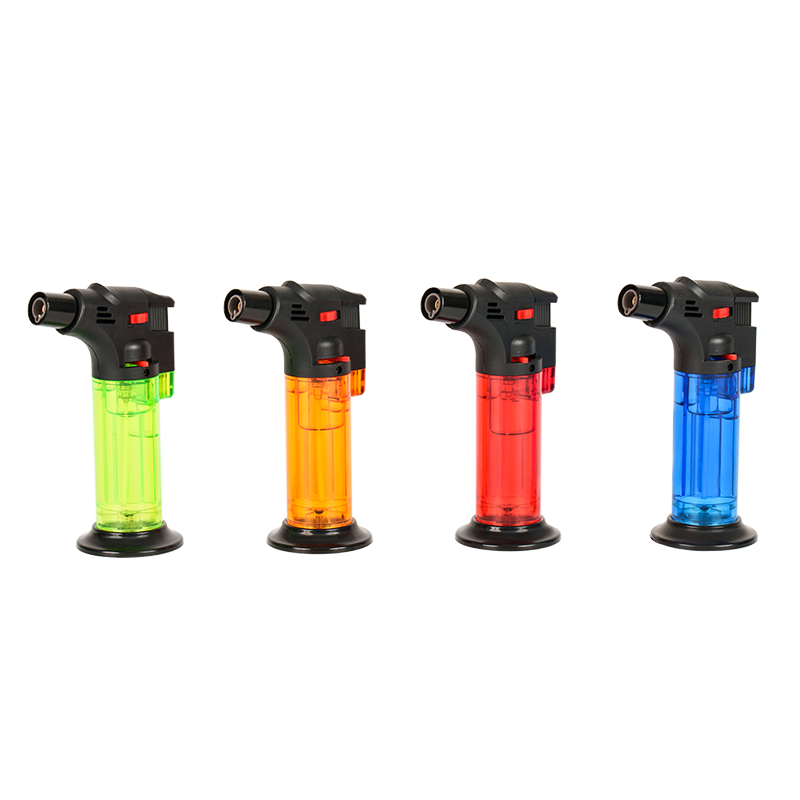 JH101 Gun Jet Flame Lighter for Kitchen and Cigar LightingA 76 g gun-style lighter with large gas capacity and high flame temperature, intended for kitchen cooking and cigar lighting.View Product →
What to Check Before Ordering Jet Torches in Bulk
For a bulk order, the specifications that decide return rates are ignition type, nozzle material, valve quality, casing and the safety catch, in that order. Appearance comes after all five.
- Ignition type. Piezo ignition costs less and needs no battery, but fires less consistently in damp or freezing air. Electronic arc ignition adds a circuit and a battery or capacitor, and returns a more repeatable spark.
- Nozzle and orifice holder. Brass copes with intermittent use. Ceramic-lined holders tolerate longer continuous burns without deforming, which keeps the flame centred after hundreds of ignition cycles.
- Gas valve and refill valve. Ask for a leak specification rather than a yes-or-no answer, and for the test method used on the production line, not just on a lab sample.
- Casing. Iron shells survive drops onto concrete far better than thin plastic, but add noticeable weight. Wall thickness and coating adhesion matter more than the finish in photographs.
- Flame adjustment and safety catch. A wheel that turns too freely drifts during transport. A trigger with a two-action release reduces accidental ignition and is the usual route to child-resistance requirements in regulated markets.
- Tolerance discipline. Request documented limits on flame length and ignition success rate, measured across a defined number of fill-and-fire cycles on production tooling.
Sampling deserves the same scepticism. Golden samples are frequently hand-assembled from selected parts, so the honest comparison is between three units pulled at random from a finished batch and three bought from a competitor's shelf.
Safety and Standards Buyers Ask About
A jet torch is safe when the fuel system, the lock and the user's habits all hold together, and most reported incidents trace back to overfilling or to storage above roughly 50 degrees Celsius.
- Overfill flare. An overfilled tank has no room for liquid expansion, so the first ignition can produce a short, unusually large flame. Refill by weight where possible, and never top up a partly full torch.
- Heat exposure. Lighters and cartridges are generally rated for storage below about 50 degrees Celsius. A closed car in summer exceeds that comfortably.
- Transport. Engage the safety catch, keep the torch away from keys and coins in a bag, and let the nozzle cool for about a minute after use before pocketing it.
- Standards. ISO 9994 covers lighter safety specifications, EN 13869 covers child safety requirements in Europe, and ASTM F400 is the comparable United States consumer safety specification. The destination market decides which applies and what documentation is expected.
- Maintenance. Replace a leaking valve rather than repairing it, and never attempt to widen an orifice to increase flame size.
Customization and OEM: What to Prepare Before Requesting a Quote
Custom jet torches are mostly a case-colour and print job, so the fastest quotes reach buyers who send flame type, fuel, ignition system, print method and packaging in one message rather than across five emails.
- Flame type and reach: needle, fan or long-reach gun style.
- Ignition preference: piezo or electronic arc.
- Case and finish: iron shell or plastic, matte, gloss or plated.
- Branding method: pad printing, laser engraving or UV printing, with artwork supplied as vector files.
- Compliance needs: destination market, required test reports and whether child resistance is mandatory.
Model numbers already in production shorten development, because the nozzle and valve assembly can stay fixed while only the case and artwork change. Buyers comparing suppliers can start from the lighter range a manufacturer already builds and work backwards to the models that fit their market, which is faster than designing a new body from scratch.
Where customized graphics matter, a model with printed text on a blue flame body shows how much branding room a straight-punch torch offers before the nozzle assembly limits the layout.
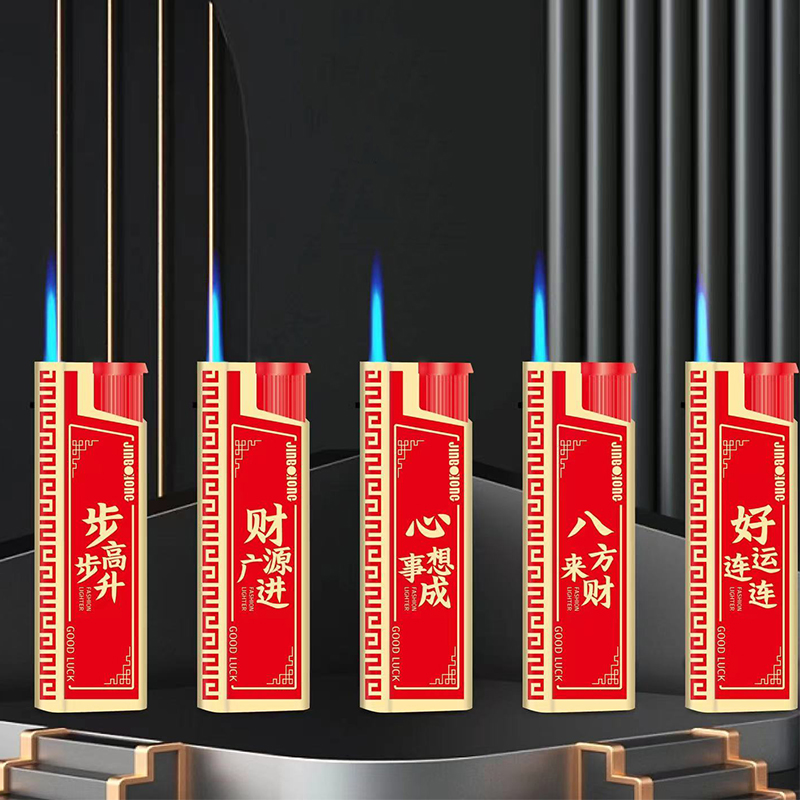 JH8057 Custom Text Blue Flame Straight Punch LighterA customizable metal straight-punch torch with engraved text, adjustable blue flame, safety shutoff, and comfortable grip for home, camping, barbecue, or gifting.View Product →
Frequently Asked Questions
Is a jet torch the same thing as a windproof lighter?
No. "Windproof" describes how well a flame resists airflow, while "jet" describes how the flame is produced. Some windproof lighters are jet torches, but many simply shield a conventional soft flame behind a metal chimney and produce no blue premixed flame at all.
Can a jet torch light a cigar evenly?
Yes, but keep the flame two to three centimetres away and rotate the cigar while drawing. A jet flame concentrates heat, so holding it close scorches the wrapper and leaves the centre unlit — the opposite of the even light most smokers want.
How long does one filling last?
Expect roughly five to fifteen minutes of continuous burn at full output, depending on tank size, flame setting and ambient temperature. Used for a few seconds at a time, one fill lasts weeks, which is why jet torches are judged on ignition reliability rather than on burn time alone.
Why does the flame sputter or shrink?
Usually one of three causes: low-purity fuel leaving deposits in the orifice, an air bubble introduced during refilling, or a partly blocked nozzle after long storage. Purging and refilling with clean butane fixes the first two; the third needs a nozzle clean or replacement.
Can a jet torch be carried in a pocket or bag?
Yes, provided the safety catch engages and the flame adjustment wheel is stiff enough not to drift. The practical risks are accidental trigger pressure from keys or coins and putting the torch away while the nozzle is still hot.
Jet torches are simple tools, and the details that separate a reliable one from a frustrating one all sit in the fuel path: orifice holder material, valve sealing, ignition consistency and honest documentation of both. Buyers who specify those four items, and who test random production units rather than golden samples, tend to hear far fewer complaints than buyers who negotiate only on unit price.