

 English
 русский
 Español
 عربى


The short answer: an engraved lighter gift works when three decisions line up first — a metal body, a flat marking panel at least 25 mm wide, and a flame type that matches how the recipient actually lights things. Artwork, font, and gift box come last, not first.
A common order tells the story. A distributor once placed 200 lighters for a client's tenth anniversary, and the first sample came back with the tagline running across the curved edge of the case. The text looked sharp on the flat face and vanished where the panel rolled away. The fix took one layout change, not a different lighter. That is the pattern with engraved lighters: the object constrains the design far more than the design constrains the object.
So the practical order of work is body material, marking method, flame type, layout, and only then the commercial details — sample, tolerance, packing, and shipping.
What Actually Makes an Engraved Lighter Worth Giving
A refillable metal lighter with a flat side panel is the only version truly worth engraving, because the mark becomes part of the object rather than a layer sitting on top of it.
Engraving is a subtractive process. A laser vaporizes or discolors the surface; a diamond tool cuts a shallow groove. Both leave a mark that will not rub off in a pocket. Pad printing, the cheap alternative, deposits ink that wears away at the corners within months of daily carry. On an ABS plastic shell there is no honest way to engrave at all — the material melts, so you are left printing on a light, curved item that most recipients quietly discard.
That is why the material matters twice over: metal accepts a crisp mark, and its weight tells the recipient the gift was not the cheapest option on the table.
| Body material | Marking result | Weight and feel | Typical gift use | Watch-outs |
|---|---|---|---|---|
| Brushed stainless steel | High-contrast laser mark | Cool, substantial | Executive and client gifts | Shows fingerprints; a clear coat helps |
| Brass | Deep, warm mark that patinas | Heaviest of the group | Anniversaries and milestones | Patina differs slightly between batches |
| Die-cast zinc alloy | Clean laser mark; plating available in many colors | Medium | Promotional and seasonal runs | Thin plating can chip at the edges |
| Painted or coated iron shell | Laser removes the coating and reveals bare metal | Durable, impact resistant | Outdoor and camping themed gifts | Contrast depends on coating thickness |
| ABS plastic | Print only, not engraving | Light | Low-cost giveaways | Marking fades; rarely kept |
Engraving Methods Compared: Laser, Rotary, and Print
Fiber laser engraving is the default for gift quantities, because it needs no tooling, holds fine detail, and produces a mark that survives years of pocket carry.
The other methods have narrow but real uses, and the choice usually comes down to volume, body shape, and how deep the mark needs to be:
- Fiber laser: typically 0.02–0.05 mm deep, setup limited to an artwork file, best contrast on stainless steel, anodized aluminum, and coated shells. Fast enough to finish a few hundred pieces in a day.
- Rotary or diamond-drag engraving: cuts 0.1–0.3 mm deep and is the most durable mark available; it looks best on brass, where the cut edge catches light. It needs a fixture per body shape and runs slower.
- CO2 laser on painted surfaces: removes the paint layer to create a two-tone logo. Cheap to set up, but contrast depends on how evenly that batch was sprayed.
- Pad printing: the budget option. Multi-color work is easy, permanence is not — expect visible wear after a year of daily use.
This is not a niche preference either. Personalized design has become a mainstream trend in the lighter market, and buyers now ask about marking before they ask about price. That shift rewards suppliers who can engrave the body they already manufacture, since the sample, the coating batch, and the final mark stay consistent.
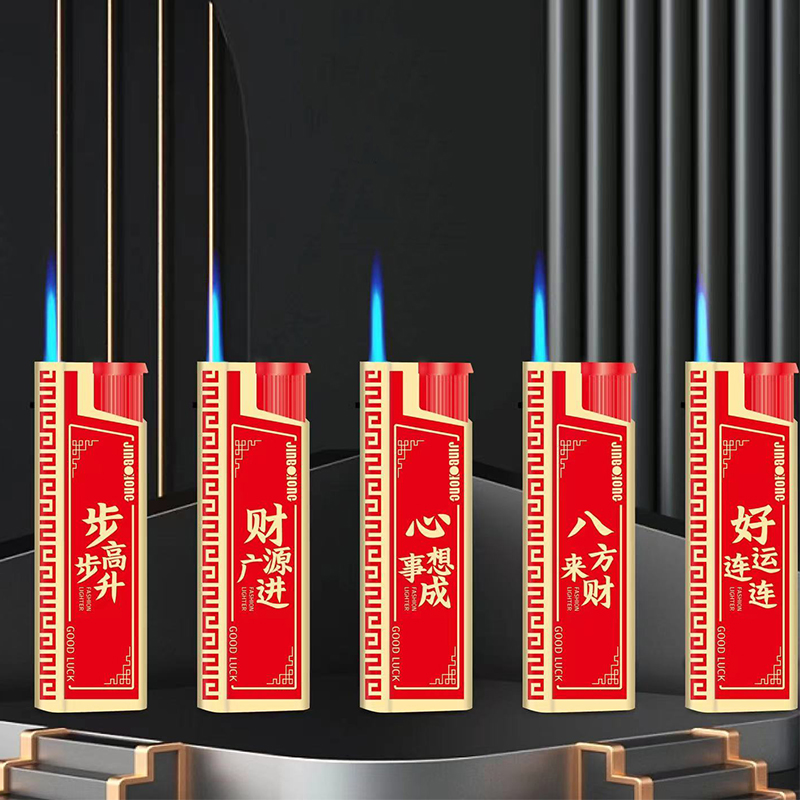 JH8057 Customized Text Blue Flame Straight Punch LighterCustomizable blue flame lighter with engraved text, flat panel for two lines, durable metal shell, and efficient blue flame for daily use or gifting.View Product →
A customized-text blue flame model is a good example of a body designed with marking in mind: the flat panel leaves room for two lines of text without crowding the ignition area.
Match the Flame Type to the Person Receiving It
Blue flame jet lighters are the safest gift default — the concentrated flame resists wind and lights a cigar evenly — while open-flame electronic models suit everyday cigarettes and candles, where a softer, wider flame is easier to aim.
Getting this wrong is the most common reason an engraved gift ends up in a drawer: a beautiful mark on a lighter that is awkward for the recipient's actual habit.
| Flame type | Behavior | Wind resistance | Best gift for | Fuel notes |
|---|---|---|---|---|
| Blue flame straight punch | Concentrated, needle-like flame | Very high | Cigar smokers, terraces, windy venues | Higher fuel consumption than a soft flame |
| Electronic windproof | Flame held in a shielded chamber, piezo ignition | High | Hiking, camping, survival kits | Standard butane, refillable |
| Electronic open flame | Steady soft flame, no flint spark | Low to moderate | Daily cigarettes, candles, home use | Refillable and cheap to run |
| Grinding wheel (flint) | Classic flame, mechanical ignition | Low | Traditional tastes, budget gifts | Wheel wears over years of use |
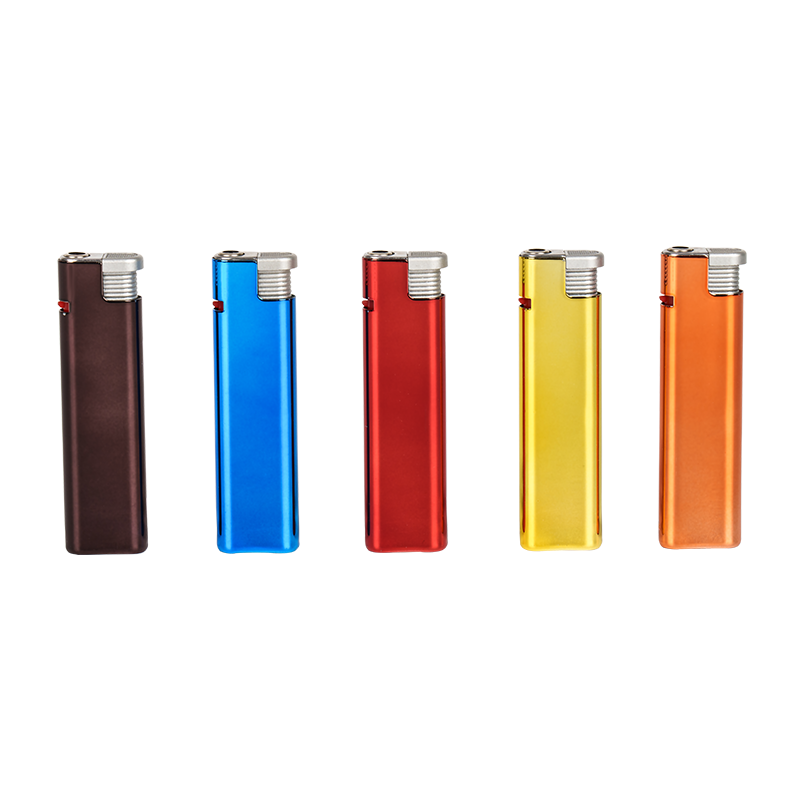 Durable Iron Shell Windproof Lighter JH805Durable iron-shell windproof lighter JH805, with high-temperature flame and 22.8 g body, suited to outdoor ignition and engraved gifts.View Product →
An iron-shell windproof body pairs well with engraving because the shell resists dents, so the mark stays flat and readable long after the first scratch.
Layout Rules: How Much Text Fits, and Where
Keep gift engraving to two lines, no wider than 25 mm, with at least 3 mm of clearance from every edge of the panel.
These limits are not arbitrary. They come from how the beam or cutter behaves at the boundary of a curved body and from how the eye reads a mark on a small object.
- Character height of 4–6 mm reads comfortably at arm's length; go to 8 mm only for a short name or monogram.
- Minimum stroke width of 0.15 mm — thinner hairlines in a script font tend to fill in on stainless steel.
- Two lines maximum on a standard 30 mm panel; three lines at 3 mm height look cramped and fussy.
- Supply vector artwork only (AI, EPS, or SVG) with text converted to outlines, so a missing font never changes the finished gift.
- Expect a position tolerance of roughly ±0.5 mm between pieces and center the design so small shifts stay invisible.
- Inspect the first piece under raking light; contrast that looks strong on a screen can wash out on brushed metal.
Ordering in Bulk: Samples, Tolerances, and Checks
Never approve a mass run of engraved lighters without a pre-production sample marked on the actual production body, in the actual finish.
Engraving goes wrong in small, repeatable ways, and almost all of them are caught by one physical sample:
- Artwork and depth: state the required depth, typically around 0.03 mm, and whether the mark should appear light or dark against the body.
- Sample check: measure position, contrast, and edge clearance with calipers rather than judging by eye.
- Coating lot: spray thickness shifts between batches, so keep one approved sample at the factory as the reference for later orders.
- Mechanism: confirm ignition still feels right after handling. Engraving sits on the shell, so the gas and ignition systems should be untouched.
- Transport: butane lighters fall under UN 1057 and are usually shipped without fuel, so confirm the carrier's rules before quoting delivery.
- Packaging: a foam or molded insert stops the lighter rattling, which is what scratches engraved panels in transit.
- OEM details: instruction language, warning text, and retail box artwork should all be approved in the same round as the engraving.
Engraved Lighter Gift FAQ
Can a painted iron shell lighter be engraved?
Yes. A fiber laser removes the paint and exposes the metal beneath, creating a clean two-tone mark. Contrast depends on coating thickness, so always test on one piece from the actual batch before the full run.
Does laser engraving wear off?
No. Laser engraving changes the material itself rather than adding ink, so it does not fade or peel. Printed logos, by contrast, typically show edge wear within a year of daily pocket carry.
How many pieces do I need to order?
Laser engraving requires no tooling, so the minimum is usually set by the lighter model rather than by the marking. Runs of a few hundred pieces are practical, and larger volumes mainly lower the unit price.
Is an engraved lighter a good corporate gift?
Yes, when the lighter is refillable and actually used. A lighter that lives in a pocket, a car, or a glovebox keeps a brand in view far longer than a printed mug or a notebook.
Which is better for a gift: blue flame or open flame?
Blue flame for cigar smokers and anyone lighting up outdoors, open flame for people who mainly light candles and cigarettes indoors. If you are unsure, the windproof electronic model covers the widest range of recipients.
Choosing a Supplier for an Engraved Lighter Gift Order
Choose a supplier who builds the body and does the engraving under the same roof, because that keeps the sample, the coating batch, and the final mark consistent across repeats.
A maker such as China Cixi Jihong Electronics has produced lighters since 1995 and works as both manufacturer and trading partner, offering electronic open flame, windproof, iron shell, and blue flame straight punch models alongside OEM customization for clients who need new shapes or their own artwork. The workflow is straightforward: pick the model, send vector artwork, approve a marked sample, then confirm packing and shipping terms. If you check the flame type, the panel size, and the marking method against the person who will actually carry the lighter, the gift does its job long after the occasion is over.