

 English
 русский
 Español
 عربى
عربى


How hot is a lighter flame? The direct answer: a standard butane lighter flame burns at approximately 1,970°C (3,578°F) at its hottest point — the inner blue cone at the base of the flame. The visible orange or yellow tip that most people associate with the flame is considerably cooler, typically ranging from 300°C to 500°C (572°F to 932°F). The exact temperature depends on the fuel type, oxygen availability, flame size adjustment, wind conditions, and the specific lighter design. This article breaks down every factor that affects lighter flame temperature, compares different lighter types, and explains what those temperatures mean in practical terms.
The Science Behind Lighter Flame Temperature
A lighter flame is not a single uniform temperature — it is a complex combustion reaction with a distinct thermal gradient from base to tip. Understanding this gradient is key to understanding how hot a lighter flame actually gets.
When butane (C₄H₁₀) — the fuel used in the vast majority of pocket lighters — exits the nozzle and ignites, it reacts with oxygen in a two-zone combustion process:
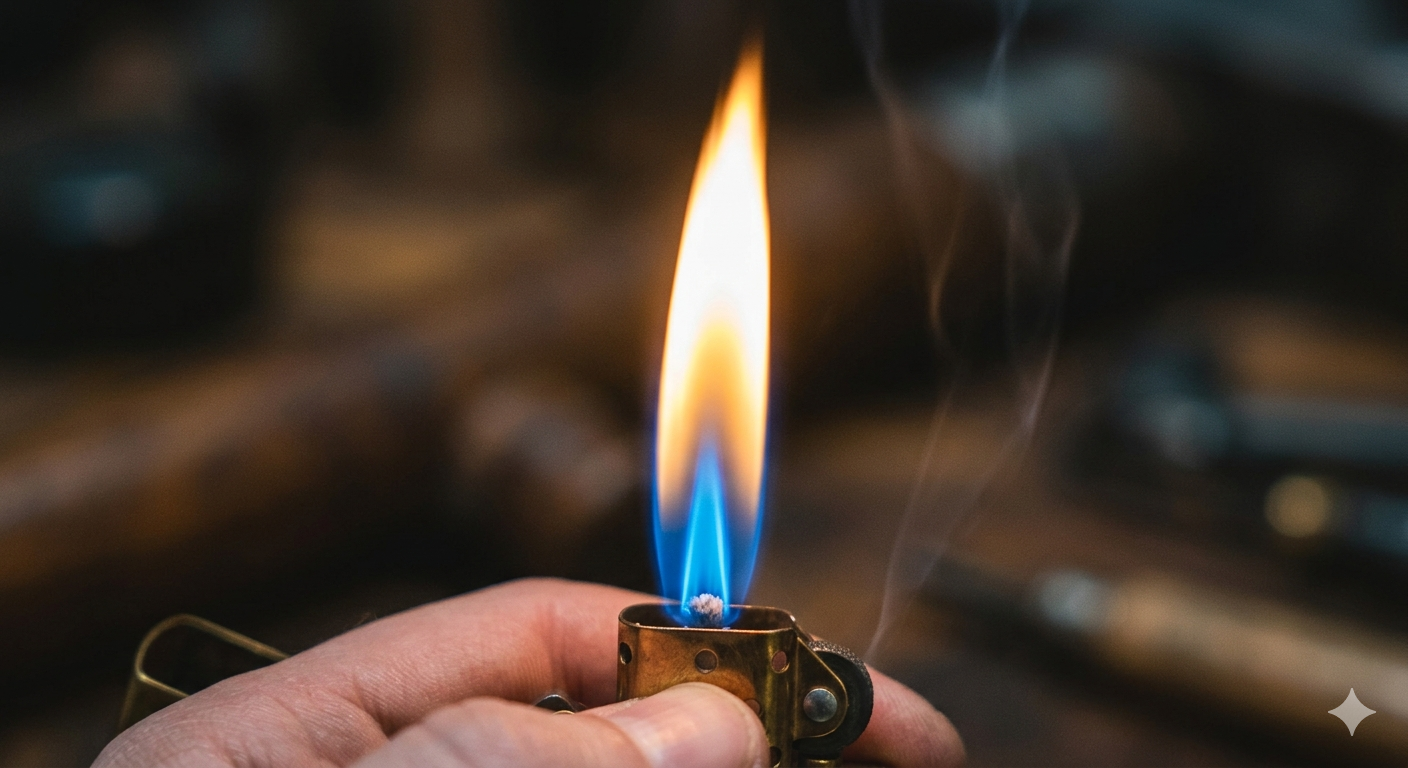
- Inner zone (blue cone): This is where primary combustion occurs. Fuel-rich conditions and direct oxygen contact produce the hottest temperatures — around 1,970°C (3,578°F). The blue color comes from excited CH and C₂ radicals emitting specific wavelengths of light during the reaction.
- Outer zone (orange/yellow flame): Incomplete combustion products — unburned carbon particles (soot) — glow incandescently at much lower temperatures, typically 300°C–500°C (572°F–932°F). The yellow color is blackbody radiation from these hot carbon particles, not from the combustion reaction itself.
- Flame tip: The very tip of the flame, where combustion is nearly complete and hot gases are mixing with cooler ambient air, reaches temperatures of 200°C–400°C (392°F–752°F).
The complete combustion equation for butane is: C₄H₁₀ + 6.5 O₂ → 4 CO₂ + 5 H₂O + heat. The theoretical adiabatic flame temperature for butane combustion in air is approximately 1,970°C — a value that assumes perfect insulation and complete combustion with no heat loss. Real-world lighter flames lose heat to the surrounding air and the lighter body itself, so the average flame temperature is lower, but the inner cone still approaches this theoretical maximum.
Lighter Flame Temperature by Type: A Full Comparison
Not all lighters burn at the same temperature. Fuel type, airflow design, and nozzle geometry all influence lighter flame temperature significantly. The table below compares the most common lighter types:
| Lighter Type | Fuel | Max Flame Temp (°C) | Max Flame Temp (°F) | Flame Color | Wind Resistance |
|---|---|---|---|---|---|
| Standard Butane Lighter | Butane (C₄H₁₀) | ~1,970 | ~3,578 | Yellow-orange | Poor |
| Torch / Jet Lighter | Butane (pressurized) | 1,300–1,600 | 2,372–2,912 | Blue | Excellent |
| Naphtha / Wick Lighter | Naphtha (lighter fluid) | ~900 | ~1,652 | Orange-yellow | Moderate |
| Plasma / Arc Lighter | Electricity (no fuel) | Up to 3,000+ | Up to 5,400+ | Purple/white arc | Excellent |
| Propane Torch Lighter | Propane (C₃H₈) | ~1,980 | ~3,596 | Blue | Good |
| Windproof Lighter (insert) | Naphtha | ~800–1,000 | ~1,472–1,832 | Orange-yellow | Very good |
Table 1: Maximum flame temperature comparison across common lighter types. Note that torch/jet lighters have a lower peak temperature than standard butane lighters despite appearing hotter — their blue premixed flame burns more completely and focuses heat more efficiently, making them more effective for practical tasks despite the lower theoretical maximum.
Why Torch Lighters Feel Hotter Despite Lower Peak Temperatures
Torch lighters are far more effective at heating objects than standard lighters, even though their peak flame temperature is actually lower. This apparent paradox is explained by combustion chemistry and heat transfer physics.
A standard butane lighter produces a diffusion flame — fuel and air mix as combustion occurs, producing a tall, luminous yellow-orange flame. Much of the thermal energy in this flame goes into heating combustion gases and radiating light rather than conducting heat to a target surface. The flame is also easily disrupted by air movement.
A torch lighter, by contrast, produces a premixed flame — fuel and air are mixed before ignition in precise proportions, creating a highly focused, turbulent blue jet. This design delivers three key advantages:
- Higher heat flux: The focused jet directs thermal energy onto a small target area at rates of 50–200 kW/m², versus 10–30 kW/m² for a diffusion flame lighter.
- Reduced heat loss: The turbulent, compact flame loses far less energy to the surrounding air than the broad, slow-moving diffusion flame.
- Wind immunity: The pressurized fuel jet maintains flame geometry even in winds up to 80 km/h (50 mph), making torch lighters reliable outdoors.
In practical terms, a torch lighter will ignite a cigar in 3–5 seconds, whereas a standard butane lighter may require 10–20 seconds for the same task — despite the standard lighter's theoretically higher maximum temperature.
Naphtha Lighter vs. Butane Lighter: How Fuel Affects Flame Temperature
The fuel inside a lighter is the single biggest determinant of its flame temperature. Butane and naphtha are the two dominant lighter fuels, and they differ significantly in combustion properties.
Butane (C₄H₁₀) has a higher energy density per unit volume (approximately 29 MJ/L liquid) and burns more cleanly than naphtha. Its adiabatic flame temperature in air is ~1,970°C. Butane is a gas at room temperature and pressure, which means it exits the lighter nozzle as a vapor ready for immediate combustion — contributing to the clean, odorless burn.
Naphtha (a liquid petroleum distillate, also known as lighter fluid) burns at a significantly lower temperature — approximately 900°C — and produces a broader, more luminous yellow flame with more visible soot. Naphtha lighters use a wick to draw fuel to the combustion zone by capillary action, an inherently less controlled delivery mechanism than butane's pressurized valve. The lower flame temperature and more diffuse combustion make naphtha lighters less efficient for precision heating tasks, but the larger flame and longer burn time (on a single fill) suit outdoor use and fire-starting.
| Property | Butane Lighter | Naphtha Lighter |
|---|---|---|
| Peak Flame Temperature | ~1,970°C (3,578°F) | ~900°C (1,652°F) |
| Flame Color | Blue base, yellow tip | Orange-yellow throughout |
| Fuel State | Gas (vapor) | Liquid (wick-fed) |
| Odor | Nearly odorless | Noticeable petroleum odor |
| Soot Production | Low | Moderate–High |
| Refillable | Yes (most models) | Yes |
| Performance in Cold | Degrades below 0°C | Reliable to −20°C |
| Best Use | Everyday, cigars, precision ignition | Outdoor, survival, campfire |
Table 2: Head-to-head comparison of butane and naphtha lighter flame properties. Butane produces a significantly hotter flame; naphtha performs better in cold environments.
Lighter Flame Temperature in Context: What Can It Actually Melt, Burn, or Ignite?
Knowing that a lighter flame burns at ~1,970°C is more meaningful when compared against the melting and ignition points of everyday materials. These comparisons reveal both the impressive thermal power of a small lighter and its practical limitations.
| Material | Critical Temperature (°C) | Lighter Can Reach It? | Notes |
|---|---|---|---|
| Paper (ignition point) | 233°C | Yes | Even the cool flame tip exceeds this |
| Wood (ignition point) | 250–300°C | Yes | Flame tip is sufficient |
| Lead (melting point) | 327°C | Yes | Easily melted with sustained flame |
| Tin (melting point) | 232°C | Yes | Melts readily under direct flame |
| Solder (melting point) | 183–190°C | Yes | Torch lighter preferred for consistency |
| Aluminum (melting point) | 660°C | Marginal | Thin foil only; bulk aluminum will not melt |
| Glass (softening point) | 700–900°C | Marginal | Only torch lighter; slow heat transfer |
| Copper (melting point) | 1,085°C | No | Flame temperature insufficient for bulk metal |
| Iron / Steel (melting point) | 1,370–1,538°C | No | Lighter flame cannot sustain required heat flux |
| Gold (melting point) | 1,064°C | No | Peak temp is theoretically sufficient but heat loss prevents it |
Table 3: Real-world material benchmarks versus lighter flame temperature. While the peak temperature of a butane lighter flame is theoretically high enough to melt gold (1,064°C), in practice the limited heat flux and rapid heat dissipation in bulk metals prevent this.
Factors That Affect How Hot a Lighter Flame Burns
The measured lighter flame temperature varies considerably depending on several controllable and environmental variables. Understanding these helps explain why the same lighter can perform very differently in different conditions.
1. Oxygen Availability
Oxygen is the oxidizer in the combustion reaction — without sufficient oxygen, combustion is incomplete and flame temperature drops sharply. At altitude (e.g., 3,000 meters above sea level), oxygen partial pressure is ~30% lower than at sea level, reducing flame temperature by approximately 150–200°C and producing a larger, more luminous (incomplete combustion) flame. In an enclosed space where oxygen is depleted, a standard butane lighter flame can drop below 800°C.
2. Flame Size Adjustment
Many refillable lighters have an adjustable gas valve. A larger flame setting releases more fuel per second, which — if air entrainment keeps pace — can maintain or slightly increase combustion temperature. However, oversized flames on small lighters often run fuel-rich (not enough oxygen relative to fuel), which drops temperature and increases yellow luminescence and soot production.
3. Ambient Temperature
Butane's vapor pressure drops significantly in cold weather. Below 0°C (32°F), butane fuel struggles to vaporize adequately, reducing fuel flow to the burner and causing weak, low-temperature flames or complete ignition failure. Isobutane blends (used in many outdoor lighters) remain effective down to −10°C (14°F). Naphtha lighters maintain reliable performance to −20°C (−4°F) due to their liquid fuel delivery system.
4. Wind Speed
Wind disrupts the flame envelope, mixing cold air into the combustion zone and rapidly reducing flame temperature. Even a light breeze of 10 km/h (6 mph) can reduce the effective heating temperature of a standard butane lighter flame by 30–40%. This is why torch (jet) lighters are preferred outdoors — their pressurized fuel jet maintains the combustion geometry against wind interference.
5. Fuel Purity
Lower-purity butane (common in cheap disposable lighters) contains more propane, methane, and other hydrocarbons as impurities. These alter combustion stoichiometry and can reduce maximum flame temperature by up to 100–150°C. Premium triple-refined butane used in high-end refillable lighters burns cleaner and closer to the theoretical maximum temperature — which is why cigar enthusiasts insist on it for flavor-neutral lighting.
Safety Implications of Lighter Flame Temperature
At nearly 2,000°C at the inner cone, a lighter flame is hot enough to cause severe burns, ignite most common materials, and damage sensitive components in seconds. A few critical safety points:
- Skin contact: Human skin begins to experience pain at 44°C and sustains full-thickness burns at 70°C after just 1 second of contact. Even the relatively "cool" outer flame zone of a lighter (300–500°C) causes immediate third-degree burns on contact.
- Aerosol and flammable liquid proximity: The ignition temperature of common aerosol propellants (propane, butane) is 405°C and 405°C respectively — well within the range of even a lighter's outer flame. Never operate a lighter near pressurized aerosol containers, fuel canisters, or flammable liquid vapors.
- Lighter body temperature: After extended use (30+ seconds of continuous flame), the lighter body itself heats up significantly — the metal wheel and body can reach 60–90°C, enough to cause burns on prolonged skin contact. This is one reason lighters include child-safety mechanisms that limit continuous burn time.
- Leaving lighters in vehicles: The internal temperature of a car parked in summer sun can reach 70–80°C — approaching the temperature at which plastic lighter bodies deform and gas pressure builds to dangerous levels. Never leave lighters in direct sunlight inside closed vehicles.
Frequently Asked Questions About Lighter Flame Temperature
Q1: Is a lighter flame hot enough to sterilize a needle?
Yes, but with an important caveat. Bacterial sterilization requires sustained exposure to temperatures above 121°C (250°F) for steam sterilization, or dry heat above 160°C (320°F) for at least 2 hours. A lighter flame at 300–500°C on the needle's surface will kill surface bacteria within seconds — heating until the metal glows red is the standard field method. However, this method does not sterilize in the clinical sense (it does not destroy all spores and prions) and should only be used when no medical alternative is available. Always allow the needle to cool before use.
Q2: How does a lighter flame compare to a candle flame?
A candle flame burns at approximately 1,400°C (2,552°F) at its hottest point (the base of the inner cone), which is significantly cooler than a butane lighter's ~1,970°C. The visible outer portion of a candle flame — the orange/yellow glow — is between 800°C and 1,200°C, notably hotter than the equivalent zone in a standard butane lighter (300–500°C). This is because candle wax (a complex hydrocarbon) burns with a richer fuel mixture and more soot incandescence than the cleaner butane combustion.
Q3: Can a lighter flame cut or weld metal?
No — the heat flux from a pocket lighter is far too low to cut or weld metal, even though the peak temperature theoretically exceeds the melting points of many non-ferrous metals. The amount of energy delivered per unit time per unit area (heat flux) is the limiting factor. A pocket lighter delivers roughly 5–20 watts to a target surface; welding and cutting requires 1,000–10,000 watts or more concentrated in a tiny spot. Thin metal foils (aluminum foil, gold leaf) can be melted by direct sustained flame application, but bulk metal objects simply conduct heat away faster than a lighter can supply it.
Q4: Why does the flame turn blue when you adjust a lighter to its highest setting?
At a higher fuel flow setting, more air is entrained into the combustion zone relative to fuel, shifting the flame toward a premixed combustion regime. More complete combustion produces fewer luminous soot particles (which cause the yellow glow) and more blue-emitting excited molecules (CH radicals). A fully blue flame indicates near-stoichiometric or slightly fuel-lean combustion — the hottest and most efficient state for a gas flame. If the flame turns blue throughout (not just at the base), the combustion is operating close to its theoretical maximum efficiency.
Q5: How hot is a plasma lighter compared to a butane lighter?
A plasma (arc) lighter generates an electrical arc at temperatures ranging from 3,000°C to over 10,000°C at the arc itself — far exceeding a butane lighter's ~1,970°C. However, the arc is extremely narrow (0.5–2 mm wide) and the total energy delivered per ignition event is low (most arc lighters operate at 3.7V lithium battery voltage, delivering 2–5 watts). Plasma lighters excel at igniting paper and thin materials that the arc directly contacts, but cannot heat large surface areas the way a sustained flame can.
Q6: Does a lighter flame get hotter as the fuel runs out?
Slightly, in some cases. As a butane lighter's fuel supply depletes, the gas pressure inside drops and the fuel flow rate decreases — producing a smaller, weaker flame. However, a smaller flame can sometimes achieve a higher proportion of blue premixed combustion, meaning the flame is proportionally hotter even if it delivers less total heat energy. In practice, a nearly-empty lighter produces a weaker, less useful flame despite potentially operating at a slightly higher efficiency ratio.
Conclusion: Lighter Flame Temperature Is More Complex Than a Single Number
The answer to how hot is a lighter flame is not a single figure — it is a range spanning from ~200°C at the cool flame tip to nearly 2,000°C in the inner blue cone of a butane lighter, with the specific value depending heavily on fuel type, oxygen supply, flame size, wind, and ambient temperature. A standard butane lighter peaks at approximately 1,970°C (3,578°F) under ideal conditions; naphtha lighters reach only ~900°C; torch lighters burn at 1,300–1,600°C but deliver heat far more effectively through their focused premixed flame.
For practical applications — lighting candles, igniting campfires, soldering small wires, or heating a metal implement in the field — understanding where the heat is in a lighter flame (the base, not the tip) and which lighter type best matches the task makes a real difference in outcome. And for safety, respecting the fact that even the relatively "cool" outer flame zone exceeds 300°C reminds us that a lighter, however small, is a serious source of thermal energy that demands careful handling.